Tuesday, December 1, 2015

Stem cell research


What are stem cells, and why are they important?


Stem cells have the remarkable potential to develop into many different cell types in the body during early life and growth. In addition, in many tissues they serve as a sort of internal repair system, dividing essentially without limit to replenish other cells as long as the person or animal is still alive. When a stem cell divides, each new cell has the potential either to remain a stem cell or become another type of cell with a more specialized function, such as a muscle cell, a red blood cell, or a brain cell.

Stem cells are distinguished from other cell types by two important characteristics. First, they are unspecialized cells capable of renewing themselves through cell division, sometimes after long periods of inactivity. Second, under certain physiologic or experimental conditions, they can be induced to become tissue- or organ-specific cells with special functions. In some organs, such as the gut and bone marrow, stem cells regularly divide to repair and replace worn out or damaged tissues. In other organs, however, such as the pancreas and the heart, stem cells only divide under special conditions.

Until recently, scientists primarily worked with two kinds of stem cells from animals and humans: embryonic stem cells and non-embryonic " somatic or adult" stem cells. The functions and characteristics of these cells will be explained in this document. Scientists discovered ways to derive embryonic stem cells from early mouse embryos more than 30 years ago, in 1981. The detailed study of the biology of mouse stem cells led to the discovery, in 1998, of a method to derive stem cells from human embryos and grow the cells in the laboratory. These cells are called human embryonic stem cells. The embryos used in these studies were created for reproductive purposes through in vitro fertilization procedures. When they were no longer needed for that purpose, they were donated for research with the informed consent of the donor. In 2006, researchers made another breakthrough by identifying conditions that would allow some specialized adult cells to be "reprogrammed" genetically to assume a stem cell-like state. This new type of stem cell, called induced pluripotent stem cells (iPSCs) will be discussed in a later section of this document.

Stem cells are important for living organisms for many reasons. In the 3- to 5-day-old embryo, called a blastocyst, the inner cells give rise to the entire body of the organism, including all of the many specialized cell types and organs such as the heart, lungs, skin, sperm, eggs and other tissues. In some adult tissues, such as bone marrow, muscle, and brain, discrete populations of adult stem cells generate replacements for cells that are lost through normal wear and tear, injury, or disease.

Given their unique regenerative abilities, stem cells offer new potentials for treating diseases such as diabetes, and heart disease. However, much work remains to be done in the laboratory and the clinic to understand how to use these cells for cell-based therapies to treat disease, which is also referred to as regenerative or reparative medicine.
Laboratory studies of stem cells enable scientists to learn about the cells’ essential properties and what makes them different from specialized cell types. Scientists are already using stem cells in the laboratory to screen new drugs and to develop model systems to study normal growth and identify the causes of birth defects.
Research on stem cells continues to advance knowledge about how an organism develops from a single cell and how healthy cells replace damaged cells in adult organisms. Stem cell research is one of the most fascinating areas of contemporary biology, but, as with many expanding fields of scientific inquiry, research on stem cells raises scientific questions as rapidly as it generates new discoveries. Source

NO COPYING ALLOWED!!!


What is Plagiarism?

plagiarism is an act of fraud. It involves both stealing someone else's work and lying  about it  

afterward.

In order to understand plagiarism, it helps to understand the process of sharing and creating ideas in the university. All knowledge is built from previous knowledge. As we read, study, perform experiments, and gather perspectives, we are drawing on other people’s ideas. Building on their ideas and experiences, we create our own. When you put your ideas on paper, your instructors want to distinguish between the building block ideas borrowed from other people and your own newly reasoned perspectives or conclusions. You make these distinctions in a written paper by citing the sources for your building block ideas. Providing appropriate citations will also help readers who are interested in your topic find additional, related material to read—in this way, they will be able to build on the work you have done to find sources.
Think of it this way: in the vast majority of assignments you’ll get in college, your instructors will ask you to read something (think of this material as the building blocks) and then write a paper in which you analyze one or more aspects of what you have read (think of this as the new structure you build). Essentially, your instructors are asking you to do three things:
  • Show that you have a clear understanding of the material you’ve read.
  • Refer to your sources to support the ideas you have developed.
  • Distinguish your analysis of what you’ve read from the authors’ analyses.
When you cite a source, you are using an expert’s ideas as proof or evidence of a new idea that you are trying to communicate to the reader.

Paraphrasing means taking another person’s ideas and putting those ideas in your own words. Paraphrasing does NOT mean changing a word or two in someone else’s sentence, changing the sentence structure while maintaining the original words, or changing a few words to synonyms. If you are tempted to rearrange a sentence in any of these ways, you are writing too close to the original. That’s plagiarizing, not paraphrasing.
Paraphrasing is a fine way to use another person’s ideas to support your argument as long as you attribute the material to the author and cite the source in the text at the end of the sentence. In order to make sure you are paraphrasing in the first place, take notes from your reading with the book closed. Doing so will make it easier to put the ideas in your own words. When you are unsure if you are writing too close to the original, check with your instructor BEFORE you turn in the paper for a grade. So, just to be clear—do you need to cite when you paraphrase? Yes, you do!


Phantom of the Opera

" The Phantom of the Opera"


We begin with a picture of the Paris Opera House -- the Opera Populaire -- in 1917 which is lit by a single small candle, and slowly fade into black and white reality. There is an auction going on there, and we come in the same time as the now seventy year old Raoul (Patrick Wilson in makeup). He enters in his wheelchair with the help of his assistants just as the auctioneer has finished giving away an old poster of the house production of Hannibal to the old Meg Giry (Jennifer Ellison, also in makeup). The next item up is an old papier-mache music box with a monkey playing the cymbals on top (important piece). Meg and Raoul do a small friendly bidding war for it, but Meg eventually lets Raoul get it for thirty francs. He muses on how well Christine was able to describe it to him (from what he says, we can figure out that she's now deceased). Next up for auction is an old chandelier which figures into the mystery of the "Phantom of the Opera." Parts of it have recently been fitted with electrical wiring, and the auctioneer gives the order to light it up. It lights, and we journey back to 1870.

In 1870, we see the house rehearsing for Hannibal as the current opera manager, M. Lefevre, is showing his replacements, Ms. Firmin (CiarĂ¡n Hinds) and Andre (Simon Callow) around, interrupting rehearsal, much to the displeasure of the house star, Carlotta (Minnie Driver). Lefevre points out Firmin and Andre as his replacements, but Carlotta storms off, leaving Andre and Firmin to, as Lefevre puts it, "Grovel." After this, Madame Giry (Miranda Richardson) comes along and starts directing the new guys around rehearsel. At this point Raoul -- looking young, strong, and impeccable -- comes in and walks right past his childhood friend Christine (Emmy Rossum). He doesn't notice her, and Christine says to Meg (her best friend) that he likely forgot her, but Meg thinks it more likely he just didn't see her. Raoul exits as quickly as he came in -- not sure why -- and the managers start touring the stage. Andre notices one promising and one beautiful dancer -- Meg and Christine (Emmy Rossum), respectively. Lefevre points out that Meg is Madama Giry's daughter and while Christine is really the daughter of a deceased Swedish violinist, Madame Giry loves her like a daughter. Rehearsals continue, but with Carlotta still mad, they don't get far. Andre grovels some more and requests she sing a magnificent piece from Act Three of the opera, "Think of Me." Carlotta "allows" it, turns to the conductor, M. Reyer, and starts to sing. Before she can get too far, though, we see a shadowy figure cut some ropes, and a backdrop falls to the stage on top of Carlotta. People yell at the stagehand, Joseph Buquet (Kevin McNally), but Buquet says that there's no one there, so it must be a ghost. The ballet girls titter, and Carlotta storms off, followed by the chief tenor, Ubaldo Piangi (Victor McGuire), who looks at the new guys and says, "Amateurs." The managers ask if there's an understudy, but there isn't one. To top it off, Madame Giry comes up with a note from the Phantom, welcoming the managers to his opera house and requesting that they continue to leave box five open for him and continue paying him his ssalary of twnty thousand francs a month. They scoff, but Giry just goes on saying that maybe with the vicomte de chagny (Raoul) as their patron, they'll be able to afford more. Firmin rounds on her saying he wanted to publicly announce that at tonight's show, which now won't happen in all likelihood. Just then, Meg volunteers Christine to fill in. Christine reluctantly steps forward to audition, and...
...we fade to Christine singing "Think of me" on stage in a beautiful soprano. Raoul (in box five--oops) sees her, recognizes her, and cheers louder than the rest of the house. While Christine finishes the song, Raoul runs out to try to find some flowers for her. Later, while the after party is going on, Christine is in a chapel lighting a candle for her dead father. Meg comes in and asks where she's been hiding. Christine smiles and says that her father once told her that when he died, he would send her the Angel of Music to help her sing perfectly ("Angel of Music"). Meg takes Christine back to her dressing room, where Madame Giry gives her (Christine, I mean) a rose with a black ribbon around it. Giry tells Christine that she sang very well and that, "He will be pleased." Christine looks at the rose and wonders what it means and who sent it, though she seems to have a good idea...
Meanwhile, Raoul is trying to work his way away from Firmin and Andre, who have a basket of flowers for Christine, or "their discovery." Raoul takes the basket, and he and Christine have a little reunion ("Little Lotte"). She tells him about the Angel, and Raoul agrees that she has been visited and they should celebrate by goiing out to dinner. Christine protests, but Raoul doesn't listen and heads out, closing the door behind him. After he leaves, we see a gloved hand insert a key into the lock in Christines door and turn it, shutting her in and everyone else out. Inside, Christine is changing when an unexplainable wind starts blowing out the candles in the room. She then hears the Phantom (her Angel, in case you haven't guessed) and she apologizes for wanting to go out with Raoul and begs him reveal himself ("The Mirror). He does, appearing to her in the mirror, which she then seems to go through...and emerges into a tunnel, where the Phantom (Gerard Butler) is waiting. He takes her deep underground and across a lake ("The Phantom of the Opera") to his home beneath the opera, complete with swan shaped bed, mirrors, and a mannequin of Christine wearing a wedding dress ("The Music of the Night"). Upon seeing all this, Christine faints. The Phantom catches her and puts her in bed for the night.
Meanwhile, Meg is upstairs (well, I guess you'd call it that...) looking for Christine. She gets into Christine's room and notices a light coming from behind the mirror. She pushes the mirror and finds the passage the Phantom and Christine were going down earlier. She starts down it but is discovered by her mother. They leave and on their way back overhear Buquet pretending to be the Phantom and demonstrating how to fight off the Phantom's Punjab Lasso ("Magical Lasso") Madame Giry cautions him to be quiet, lest he get killed by the lasso.
At this point, we hop back to 1917. We see Raoul holding the monkey tightly, and being wheeled out of the opera house. He and Meg see each other and smile briefly before Raoul gets into his car and heads for home.
Back in 1870, Christine is awakened in the Phantom's lair by a certain toy monkey. She wanders around talking to herself about what happened last night, ("I Remember..."). The Phantom looks at her briefly and then goes back to writing some music (VERY important). Christine approaches him slowly, and then innocently takes his mask off. She screams, and is rounded upon by the Phantom (we don't see his face yet). He yells at her, but soon changes his tune (sorry) and says that he's human inside ("Stranger than you dream t it..."). She takes pity on him and returns the mask. He replaces it, gets up, and then tells her that they have to get her back, because "...those two fools who run my theater will be missing you."
Speaking of Firmin and Andre, they are outraged at the papers reports of Christine's disappearance and offended by notes to them from the Phantom ("Notes"), one demanding his payment (for Firmin) and the other insulting Carlotta (Andre). As if that weren't enough, Raoul comes in with a note he thinks is from the managers telling him to avoid seeing Christine, who is under the care of the Angel of Music. As if THAT weren't enough, Carlotta and Piangi come up with a note for her (three guesses who wrote it and the first two don't count) that she thinks is from Raoul saying that Christine is going to be taking Carlotta's place. Andre and Firmin voice their hatred of all these notes when Meg and Madame Giry come up saying that Christine has returned. Giry also has another note. This one says that the Phantom has "...now sent them several notes of the most amiable nature, detailing how my thater is to be run. You have not followed my instructions. I shall give you one last chance." He commands them to put Christine in the lead role for that nights production of "Il Muto" (Itailian for "The Mute") and put Carlotta in the silent role, but in a vast appeal to Carlotta ("Prima Donna"), they refuse, despite the confusion and outage and protestations of Raoul, Giry, and Meg.
That night, at the opera, things are going well for everyone ("Poor fool...") until the Phantom announces his presence. Christine freaks, and Carlotta yells at her, gets her throat moistened...and then starts croaking, since the Phantom switched water with some kinda salve or something. Anyway, the managers say that the performance will continue in ten minutes with Christine in the lead role. They then arrange for a set called "The Ballet" from act three to be performed, and this happens while Buquet, who saw the Phantom earlier, pursues him across the rafters...and ends up getting choked with the lasso and thrown onto the stage. Christine and Raoul head for the roof and safety ("Why have you...") where Christine tells Raoul what she saw beneath the opera ("Raoul, I've been there..."). Raoul comforts her and the two confess their love for each other ("All I ask of you"). They head back inside as a heartbroken Phantom swears revenge on the pair ("All I ask of you [reprise]")
We head back to 1917 for a minute and see Raoul leaving his house in the country, still holding tightly to the musical monkey box.
Back in 1870, we have jumped six months ahead in time, to a new year's masquerade ball ("Masquerade"). The Phantom hasn't been seen in all that time, the opera is doing splendid business, and Christine and Raoul are happily engaged...until the Phantom crashes the party dressed as Red Death and bringing with him a new opera ("Why so silent...") and insults for everybody (Piangi = too fat; Carlotta = can't act; Firmin and Andre = interfering idiots). Raoul runs out to find his dueling sword, since the Phantom has brought his own sticker with him. He gets back in time to see the Phantom snatch Christine's ring away and vanish in a flash of flame. Raoul dives after him and lands in a dark room full of mirrors, all showing the Phantom. He tries to get the Phantom, but all he hits is air. Suddenly, madame Giry comes up behind him and gets him out of there. He convinces her to tell him what she knows of the Phantom. She confesses that when she was a young girl in the ballet, she visited a traveling circus and there saw a teenage boy who was locked in a cage and was billed as some kind of freak show. The night she was there, the boy broke loose, killing his master, and young Madame Giry helped the young Phantom to escape. She hid him in the opera house, where he became a genius of sorts -- architectural, musical, you name it. However, as Raoul says, "...genius has now turned to madness"
In 1917, we see Raoul and the monkey being driven down a road when he observes a buck running alongside it.
In 1870, a few days after the party, Christine wakes up and sneaks past a sleeping Raoul, sitting outside her door. She goes to a horse master and pays him to take her somewhere. She goes to put on her coat when the horse master is knocked out. Christine gets into the coach and heads for a graveyard, now being driven there by the Phantom. Meanwhile, Raoul has woken up and borrowed a horse from the horse master and is chasing Christine's carriage. Christine arrives at the graveyard and pines for her departed father ("Wishing you were somehow here again") when she hears the Phantom speaking from somewhere ("Wandering Child").Suddenly Raoul shows up and he and the Phantom have a pretty intense sword fight. Eventually Raoul gets the better of the Phantom and is about to kill him when Christine begs him not to. Raoul lets the Phantom live and he and Christine ride the horse back into Paris. Meanwhile, the Phantom glares after them and says, "So be it...now let it be war upon you both..."
Back at the Opera, Raoul tells the managers that if they do what the Phantom wants them to, they may have a chance to end this all and capture him...if they do it right. Later, Raoul finds Christine in the chapel, where she begs him not to put her through this "ordeal by fire," since she's worried that if it doesn't work, he'll take her forever and never let her go ("Twisted Every Way"). Raoul tries to comfort her, but it seems to be cold comfort.
Later, the opera is underway with armed guards posted everywhere. The audience doesn't seem to think much of the production, but this is secondary. Onstage, "Don Juan" played by Piangi, is gloating about his next great conquest, Aminta (Christine, of course). Don Juan heads offstage to let Christine come on unobserved, but he is met by the Phantom and more importantly, the Punjab lasso. The Phantom emerges back onstage in Piangi's outfit and takes over the role, singing "Past the Point of No Return," which now contains a double meaning for the Phantom/Christine relationship. Eventually, everyone who knows about the Phantom realizes that it's him behind the mask, and at the end of the song, as the Phantom lets his guard drop and asks Christine to marry him, Christine rips off the mask, revealing a half young, half old and burned-to-a-red-tenderness face which shocks everyone into action. Infuriated, the Phantom cuts one of the ropes holding the chandelier up and disappears with Christine through a trapdoor just before the chandelier crashes, causing a spread of panic and destruction. Meanwhile, Raoul and Madame Giry and Meg have found each other, and Giry says that she will lead Raoul to the Phantom's lair, but she cautions Meg to stay behind. Raoul and Giry leave, and Meg then proceeds to lead another group down to the Phantom's lair.
While all this is happening, the Phantom is taking Christine down to his lair ("Down once more..."). He seems to have lost any restraint he once had, but still pities himself for, "...the wickedness of my abhorrent face!" As they're pursued by Raoul and the mob, the Phantom begs for pity from Christine. Meanwhile, the mob is descending ("Track down this murderer...") and Giry and Raoul have reached a point where she dare go no further. Raoul thanks her and continues the descent on his own. He finds a pool benath some kind of grate, but as soon as he's in the pool, the grate begins to lower. He tries to get some wheel turning to raise it, but it won't budge until the last second. He gets out and keeps going down.
In the lair, Christine is outfitted in the wedding dress from before while a mask less Phantom readies the veil. Christine begs him to stop, but he refuses, forcing her to accept, "an eternity of this before your eyes." She says that it's in his soul that the true distortion lies just as Raoul arrives. He begs to be let in and is granted entrance. The gate closes behind him and the Phantom advances slowly. When they're close enough to touch, the Phantom grabs up a hidden rope and ties Raoul to the gate so that if the Phantom pulls on a rope he holds, Raoul dies. Christine is forced by the Phantom to choose between living with the Phantom and saving Raoul (which Raoul begs her not to do) or refusing and getting Raoul killed. She hesitates, and then amazingly chooses the Phantom, being willing to show that he is not alone. The Phantom smiles, but then when he hears the approaching mob, he cries out and yells at Christine and Raoul to leave now, before it's too late. The Phantom heads for the toy monkey, which starts playing the tune we now know as "Masquerade." He sings along, and then turns to see Christine standing there. She steps over to him, and presses the ring into his hands, signifying a love for him as well as Raoul. She heads back for Raoul and they exit the caves in the boat. The Phantom screams out and says, "You alone can make my song take flight...it's over now--the music of the night!" He gets up and starts smashing mirrors to avoid seeing himself clearly. At last he lifts up a flap, smashes another mirror, and reveals a passageway behind it. He steps through, dropping the tent flap behind him just as Meg and the crowd enter. They search, but find nothing but the mask, which Meg holds tentatively in her hand...
In 1917, Raoul wanders to the grave of his recently deceased wife of almost fifty years, Christine. He places the monkey on a ledge sticking out on it, and then he notices something which was recently placed there--a rose with a black ribbon tied around it. Christine's engagement ring is tied to the rose with the ribbon, which was the ring Raoul gave her. He looks around as if hoping to get a glimpse of the Phantom, but of course sees nothing. The camera zooms in on the black and white rose, whose petals soon turn to red, and this turns into a picture lit up by a single small candle, which is then blown out by an unseen puff of wind...credits

Tuesday, November 17, 2015

How has the Internet affected the way we live today?


THE IMPACT OF THE INTERNET ON OUR DAILY LIFE

by Markus Temmel, Martina Theuermann, Eva Ukowitz, Tanja Vogrin


There is a big influence of technique on our daily life. Electronic devices, multimedia and computers are things we have to deal with everyday.
Especially the Internet is becoming more and more important for nearly everybody as it is one of the newest and most forward-looking media and surely “the” medium of the future.
Therefore we thought that it would be necessary to think about some good and bad aspects of how this medium influences us, what impacts it has on our social behaviour and what the future will look like.


The Internet changed our life enormously, there is no doubt about that. There are many advantages of the Internet that show you the importance of this new medium. What I want to say is that Internet changed our life in a positive way.

First we have to make a differentiation concerning the usage. You can use the Internet at home for personal or you at work for professional usage. Let’s come to the first. To spend a part of our day on the Internet is for many people quite normal. They use this kind of medium to get information about all kinds topics. Maybe some of them are interested in chatting, probably they are members of a community. Whatever you are looking for, you will find it. Even if you want to have very specific information, you will find it in a short time. Normally, you often have to send a letter, than you have to wait for the reception of the reply, or you have to make some telephone calls and so on. In any case, the traditional way is the longer one. To put your own information on the Internet is also possible. Create your own homepage, tell other users about your interests, what you want, that’s no problem at all.

As we all know, software costs a lot, if you buy it legal. Free software, free music is available on the Internet. You just have to download the program, the mp3-file or whatever and that’s it. Why do you want to pay more as you need to? Special websites are created just to give you the newest programs, or to tell you where you can get it from. Napster might actually be the most famous one.

The computer is a fix part of every modern office and the greatest part has also an access to the Internet. Companies already present their products, their services on the Internet and so they get more flexible.
The next advantage I want to mention is the faster development. Many universities and research institutions are also linked. They are able to exchange experiences, novelties and often they start new projects together. If they are linked, they can save time and money.
Especially at the business sector knowledge is power. If you are the leader of a product, of a technology or just of an idea you are able to make a lot of money. To get into this position, the Internet can play an essential part. Companies all over the world are online. If you want, it is no problem for you to exchange experiences, you will hear new things, you will see some facts from another point of view. For this reason you will find new solutions, new ways to go, so take this chance!

“Learning by doing”, everybody knows this phrase and its still an essential part concerning the Internet. Children also use the Internet, most of the time they will “play” over the Internet, but they learn to work with the computer. There is only one way to learn something, you have to do it. Even it’s the first contact with the computer, after a few minutes the person will know that the computer-mouse is no animal running on the monitor. He or she learns to write on the keyboard, to navigate, to open and close programs, to save data... within hours. Try to do that on a normal computer course for beginners, you will need more time and the most important fact, it’s not as funny as surfing on the Internet and so they participants are less motivated.

Let’s change over to another positive effect of the Internet.
In any case, everybody’s private situation is different. For many women their own children are the main reason for staying at home. Nowadays this won’t be a problem any more, you can do work on your computer at home, called tele-working. Also men take this opportunity to work at home. What are the consequences, the advantages of tele-working? Sure, if you have a family, you can spend more time at home, probably you can spend more time with your children. Next is, that you can organize every day in the way you want to. Meetings at the company are reduced to a minimum. Tele-working is also an advantage for the owner of the company. Official studies substantiate that people who work at home are more motivated than their colleagues at the office. .

You see, the Internet is really a very positive medium. Use the Internet and discover the advantages of this new, forward-looking medium!


Markus Temmel


Another advantage of the internet is that you can join a community.
You can create new social contacts all over the world, which you could not do so easy without the internet.
Such communities can also help people who can not go out to find friends in the real life because they are disabled. Therefore they can chat with other people via the internet. Sometimes it is also easier for people, who are afraid to look into the other’s face while talking, to chat with a person that they do not know. There is something between them which makes it easier for them to communicate. It also does not matter if you have a terrible appearance because you can pretend to be whatever you want. You can also change your gender and your age to talk about topics which you do not normally do.
However, there are no time and place limitations and there are no boundaries, both geographical and political. You can chat with people in Australia and you have freedom of your mind in a way.

Moreover the internet is much cheaper than the real life, e.g. phoning a friend in Australia costs more than to chat with him.
From my point of view the e-mail has replaced the traditional letter. You do not have to buy stamps anymore and it is much faster and also for free. You can also add files to your E-mail and that’s why a big data transfer is possible. Therefore you do not have to send disks with information around the world anymore and you have your information in a digital way.
Another free service of the internet is sending SMS. You can save a lot of money if you do not send it with your mobile phone especially from Austria to America. You also have the opportunity to register as a user. Then you can use more things, e.g. sending E-postcards, I-messages (messages between registered users), and lead an address book.
You can also place your digital photos in the internet. With a password and a login name your friends in America can look at your photos without sending them to them.
Another important part is online gaming. You can play with people from all over the world and share your knowledge. In my opinion it’s more exiting to play with friends than playing alone.

Additionally, another big advantage of the internet is the easy access to information. Online reference books and dictionaries replace the way to the bookshop or to the library. It is again cheaper to search for information in the internet than to buy a book, that is old after one year. In the internet a lot of information is renewed and up to date. You can also find information which is very new and a book does not exist yet.
Moreover you can read the daily newspapers from all over the world, sometimes for free. You do not have to buy them anymore. In addition, most newspaper sites have an archive in which you can search for old articles.
However, the internet is also a big “advertising company”. A lot of enterprises have a homepage with ads and support opportunities. On some of them you can order products online. Then you do not have to go to the city anymore. You avoid waiting in front of the cash because of a long queue.

Moreover, you can get the newest stock exchange courses because the stock exchange in the Internet is always the most current one. You also have the ability to tell the computer to buy shares when the course is down.
Besides you can learn with the internet. CBTs (Computer Based Training) already exist but you can also join an internet course with other members.
Furthermore you can hold videoconferences which means that e.g. your teacher is sitting in his office in America and teaching you in Austria.
This is very important in the medical sector because doctors from all over the world can join an operation. So specialists can give tips and help other doctors to complete the operation successfully. The patient has not to wait until a specialist will come from America.
But this is only available because of the internet 2 which is much faster.

The internet is a database full of information and offers us a lot of services, sometimes for free. This makes our life easier and sometimes also cheaper.
All in all I think that the internet is very useful especially for students.


Martina Theuermann


Clicking on the Internet-Button is getting more and more thrilling nowadays. Sometimes it is a real adventure not being sure if you have downloaded a virus or if it is only a hoax. You even cannot be sure to be alone if you are alone. Is there someone else working on my computer or is it only me? To have more security you have to install a firewall, buy anti-virus-programmes and update them regularly. So you have to spend much money only for preventing a virus-caused breakdown or hacker-attacks. It is annoying not being sure if the money you have spent will prevent all those things or if there is already a new virus and a new way hacking into computers. This is no more an investment into security it is a steady consumption which will not end. Some people even have to take up a loan to buy a computer. They are forced to buy one. Otherwise they maybe would not be able to stay in their job. What will the poor people do? They will be rarely informed about news and the space between rich and poor will become bigger and bigger.

Having downloaded the latest anti-virus-program it will not prevent meeting bad people on the internet. If you chat with someone you cannot be sure about the truth of his/her words. Most people cheat emotions, cheat about their appearance, age, job. That can be funny but if you want to meet someone talking to each other seriously it can be hard to do so. Is it a man, is it a woman or is it someone I already know? You never can be sure. Is that something on the other side already hacking into my computer reading personal information? If you get to a web site of a bank – is it a real bank or only a faked one? There have to be some signs which identify an original website reliably. How can I be sure if I want to buy something on the web and send my credit card-number that nobody will read it?

Imagine the following scene: You are surfing through the internet and suddenly – you are just downloading the latest screensaver of Verona Feldbusch – the whole internet breaks down. What would you do? Trying to build your own internet? Worrying about the lack of Verona? Sitting in front of the computer waiting for hours and looking into a black screen? Seriously, what would happen? I think most of the people would wait an hour or longer. Some people would stop existing because they have no real life. They only exist on the internet with their avatars in the chat rooms. They have given up reality for cyberspace. It is more practical for them because they do not need to ask someone to meet someone. The other one is just on the other end. Seriously speaking, I think people would not be glad about having to get out of their rooms. They feel uncomfortable about leaving their beloved computer. They do not know what to do. I think many even do not know any more how a book looks like or a typewriter. Besides losing our social abilities we are also losing our every-day-abilities. The computer is a nanny, a dictionary, an information centre, a job, a shopping centre. Nobody has to know anything about everyday business because the computer does it for us.

Internet user are becoming younger and younger. For children it is no problem to work with a computer. They just accept "him" as partner. But what do the older people do? Some even do not know how to switch the computer on. I know some people who are afraid of the computer. They think everything they do is wrong and the computer is breaking down on purpose. For these people the computer is already too complex. There has to be something like a computer for beginners. Otherwise there will always be some people who do not want to know how to use the computer because there is too much to know about it.

There are people who do not read the paper in the morning any more. They are reading the e-paper. Even in the morning they are sitting in front of the computer and not talking to each other while drinking a cup of tea. In the future there will be more and more e-papers and the newspapers will disappear. Some are beginning to talk to their computer (Come on, let’s work!) but they are not any more able to talk to each other. While chatting in the internet you are frequently using abbreviations, uncompleted sentences and so on. This leads to speaking disabilities in everyday life.

Eva Ukowitz


One of the most negative aspects of the impact of the internet on our daily life is, in my opinion, that it alters the social behaviour, habits and abilities of people.
Especially children are often badly influenced by the internet.
Therefore I want to deal with the impact of the internet on the social behaviour of children.

In our times, when nearly every household has a computer and access to the internet, it is only clear that also children deal with computers and the internet. They should learn how to use it, of course.
The world of the world wide web and virtual space is going to become more important with every year and everybody should be able to use this tool – even children.
They should know how to get information, how they can buy something on the web, where they can meet people online.
They should be able to use the internet because if they are not, they are going to have great difficulties with getting on in their lives without knowing how to use the internet later on. Simply because it is a very powerful media which is going to be the main medium in the future.

But what I am worrying about is that children will be very competent experts on using the internet – but not on how to live in the real world anymore.
The first point I want to mention is that I don’t consider the internet as a suitable babysitter or friend for children.
As I have already said, I think that it is important that children learn how to use the internet but it is also very important that they learn to have the right attitude towards the internet.
The internet will never replace the real world and therefore it is important that children see that the internet is a great tool if you know how to handle it but it should not be a replacement for real friends, for a real life. It’s the parents duty to tell their children so.
Parents should not just put their children in front of a computer and say “Oh well, that’s the internet, go on, have some fun and be quiet.” The internet was not made for children and so it should not be used as a babysitter.
You can never be sure what the child will get to see when it is online without an adult sitting next to it. There is so much harmful, offending and simply disgusting material on the internet, that it is – in my opinion – totally careless when you let your children surf through the net all by themselves.
By reading the emails from the discussion group I often heard that if you teach your children the basics of ethic and just tell them not to look at harmful material then they can go online and surf through the net alone. I’m not of the same opinion. Children are children and they are not adults. If you tell them not to look at – for example – pornographic sites, you can never be sure that they will not. Children are nosy ones – at least most of them are – and most children will go and have a look at pornographic materials on the internet. The only way to provide that children do not see harmful things on the internet is to sit next to them and supervise them.
I have a little brother, aged seven and when he wants to go online, then he has to ask my parents or me to come with him and sit next to him while he’s surfing. Surely, it doesn’t mean fun when you have to sit next to him and listen to the Teletubbies talking or see Mickey Mouse bowling but I am far more interested in hearing and seeing these things than in not being sure what he would see if I was not sitting next to him.
That’s the one point why the internet should not be used as a babysitter.
The other point is that it is – in my opinion – not good for the children to sit in front of the computer all day.
Children need friends and they need to play with friends to learn how to behave and how to interact with others.
Human beings are not born with any social abilities – we have to learn all of these stuff.
And if children sit in front of the computer and don’t play with other children – when and where should they learn how to behave?
Another question is whether the internet is a useful medium to educate children or not.
Well, in my opinion it is not.
Even for adults it is often a problem to say whether an information is right or wrong on the internet. So when adults are not able to be sure about it – how should children be?
The risk to learn wrong things from the internet is very big and so the internet should not be used to educate the child right from the beginning on.
But: You should try to tell your children how they can distinguish between “good” and “bad” information. (Be critically, try to figure out who has written the information, when was the last update, and so on….) Later on, they will have to get information for the internet and then they should be able to use it, of course.
But in my opinion there’s no sense to teach them the basics with the help of the internet before they have learnt how to distinguish between good and bad information – they are simply too young to be sure about that.


Tanja Vogrin


It is very difficult to differ between the good and bad aspects of internet. There are good and bad things about every service of the internet.

If you chat you can meet many interesting people which come from all over the world. Distance is not important any more. You can meet people which are not able to find friends in reality because of their appearance. In cyberspace there is no appearance - the character of a person counts. But you also can meet people, who cheat on you and fool you. That can be funny, but it is not if you want to meet “real”, devine friends. Sometimes, if you meet your online friends it can be very thrilling. You make your own picture of your chat-partner in your mind. And what about your friends in reality? There will be less time left for them, if you sit in front of the PC all the day. But there is also the possibility to make your real friends your online-friends.

Searching for information you will find a huge amount of it on every topic you are searching for. This can be very comfortable. You only have to type in a word and you will find everything about it. But be careful! There is also false information. Sometimes it is hard to distinguish between true and false information.

Often you have the possibility to listen to music on the internet. You may also download it for free. That is very cheap because you only have to pay the telephone-costs and the music is for free. What does that mean for the musicians? They will not get all their money they would normally receive. That is not too dangerous for the well-known musicians but it can become dangerous to the little ones who cannot afford to lose a part of their income.

What about communicating with an online-friend? You will send him/her an email. It is faster than a letter, cheaper than a telephone call and easier to use than a radio set. But: Is the encryption-code secure enough? Many hackers will try to read the message you send to your friends. This leads to the next problem of the internet: How can you provide privacy in a non- private world? Everybody wants to know everything about everyone. How can you say: “This is my private zone, nobody can get into it.” A few minutes later someone will try to get into the privacy-zone. Why? Everyone thinks there must be something very interesting and secret inside this zone. Nothing is more interesting than a forbidden place. There is some special anonymity about the internet. You may tell anything about yourself and everyone will believe you – if nobody checks the information. You also may swap your gender and nobody will recognise it.

What will happen, if you are ill and cannot leave the house? No problem! You can do everything on the internet without leaving the house. You can do the shopping, meet friends and so on. The only problem is the way of paying. It is very easy, you only have to type in your credit card-number and the goods will be paid. But some transmission techniques are not very safe and so someone could read your credit card-number and use it to buy things himself. You always have to inform yourself about the transmission-techniques to be sure about security. Otherwise you may pay for being uninformed later on.

This leads to the costs of the internet. The only good about it is that the surf-cost are low (depending on the provider). But anything else is very cost-intensive. You have to buy anti-virus-programmes, software, computer, … And that is not enough! Internet is developing very fast for this you have to update the programmes regularly. You will also not abandon the option to get a faster computer.

Which are the points we have agreed on?

Information is difficult to divide into true and false. It is too much information to be able to view on everything.

It is a strong positive argument that internet does not care about time or distance. Everyone can be online every time and communicate with everyone everywhere.

Though you have the possibility to meet many people on the internet frequent use of this will cause loneliness because you won’t have real friends anymore.

It is very difficult to give children access to the internet. There are many things which are not suitable for children. Either you sit next to them during surfing or you believe in the internet that it will not show harmful things and in the children that they will not try to find harmful things.Source

Lazaro Francisco: The Latest National Artist for Literature

 Lazaro Francisco Becomes the Latest National Artist for Literature


The great Tagalog writer Lazaro Francisco (1898-1980) becomes the second novelist in that language to be proclaimed National Artist for Literature. He follows the lead of Amado Hernandez, and joins the company of fellow National Artists in Writing including Francisco Arcellana, Virgilio S. Almario, N.V.M. Gonzalez, Amado V. Hernandez, Nick Joaquin, F. Sionil Jose, Bienvenido Lumbera, Alejandro R. Roces, Carlos P. Romulo, Edith L. Tiempo, and Jose Garcia Villa. (Carlos Quirino won for Historical Literature.)


Francisco was born in Orani, Bataan on February 22, 1898... He acquired his college education at the Central Luzon Agricultural college and, later, through the International Correspondence School. In 1946, his essay "Tatsulok" won in the Commonwealth Literary Contest, and became the basis of his major social novels. As a writer, Francisco earned acclaim for Ilaw sa Hilaga, considered the best novel ever written in the first decade of the Third Philippine Republic. First published as Bayang Nagpapatiwakal (Suicidal Country), it deals mostly with the detriment of economic imperialism, colonial mentality, nationalism and agricultural backwardness. It was printed in book form. His other novels which likewise gained praise and awards were Maganda Pa Ang Daigdig, Sugat ng Alaala, Bago Lumubog Ang Araw, Ama, Binhi, Daluyong, and Sa Paanan ng Krus.


The nationalism of Francisco found its concrete expression in the Kapatiran ng mga Alagad ng Wikang Pilipino (KAWIKA), a nationwide organization which he himself established in 1958 to sustain and advocate the use of Tagalog (Filipino) as a national language. He himself wrote KAWIKA’s constitution and rules.

Francisco worked in the provincial government of Nueva Ecija as provincial assessor until he retired in 1963. As provincial assessor, he fought for the rights of small farmers. It was his idea to create an agency that would protect Filipino grain raisers and traders from the abuses of foreign businessmen. Thereafter, the National Rice and Corn Corporation (NARIC) was strengthened by President Marcos and renamed National Grains Authority (NGA), during martial law. In recognition of his active nationalism and his salutary contributions to Philippine culture and literature, he was conferred the following awards: Republic Cultural Heritage Award (1970), Patnubay ng Kalinangan from the City of Manila (1975), Dangal ng Lahi, Lungsod ng Quezon (1976), Tanglaw ng Lahi from Ateneo de Manila (1979), Presidential Award of Merit for Literature, and Gawad Plaridel and Pingkain Award, both from the Bayanihan Foundation.

Francisco died on June 17, 1980 at the age of 82. Reference

He's indeed a National artist because of his achievements as a writer.

Thursday, November 5, 2015

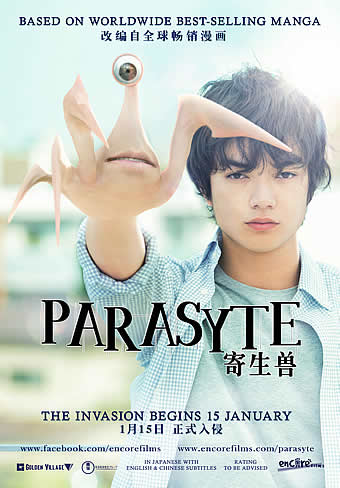
PARASITE


I liked that the characters were grounded, and that the main character Shinichi in particular was a shy, somewhat gloomy teenager.  Oftentimes in Japanese films, especially anime and manga adaptations including even highly respected Rurou ni Kenshin, the villains are simply way too over-the-top cartoony for me.  Unless I’m watching a fun, silly comedy (like Kung Fu Hustle or Dodgeball), I’d rather have the threat to feel real.  In Parasyte, the villains are subdued, somewhat approaching zombie territory but still learning to communicate as humans.  It’s not easy to be convincing with that set-up, but this cast was able to do so.  In other words, the acting was subtle enough to work, unlike typical melodramatic and over-acted manga adaptations.
I get bored easily, and while I do enjoy a good slow-paced art film every now and then, in general I want to get caught up in the story.  Even during the character set-up, the film never slows, and while there is a bit of exposition, fortunately it’s kept to a minimum, and we learn about the world through either fun dialogue, or intriguing visuals. 
It’s certainly not a perfect film, and there were particular scenes that could have been presented more effectively, and the motivations for the villains are questionable at best, leaving the set up for Part 2 unconvincing.  And the relationship between Shinichi and Satomi wants to be better explored.  But all in all, it’s a fun ride, and worth watching!

SOM WEEK!!!


Last October 26, 2015 SOM week has officially started. Of course I'm excited for the activities but unfortunately I wasn't able to participate in any but I cheered for my friends who participated in the events especially in volleyball because most of the members of MA team are my closest friends in Asia Pacific College. 

Having a SOM week is important so that students could relax for a week with no home works to do and just enjoy the week with their friends. Many lessons can be learned with this kind of project for example being fair in a game no cheating, having sportmanship and willing to accept defeats. Camaraderie can be learned also, working with your blockmates or teammates. You're united as one that's why you can win the game but not all team who are united win the game it means that they have to exert more effort and work harder to win the game.

I hope the school will maintain this kind of activity for the students. And will have more activities in the near future. I'm looking forward to it.